



 Solar Power
- What we know about solar in Montana
- How solar energy benefits Montana
- Montana's Solar Resource
- USB solar projects installed in Montana
- Solar Projects in Montana
- Links
What we know about solar in Montana
Montana has an abundant solar resource that can be used to save energy in residential and commercial construction, and farming, ranching, recreation and other industries.
How Solar Energy Benefits Montana
Solar energy can play a key role in creating a clean, reliable energy future in Montana. The benefits are many and varied. Consumers who use these technologies will benefit directly and immediately. Using solar energy produces immediate environmental benefits. Electricity is often produced by burning fossil fuels such as oil, coal, and natural gas. The combustion of these fuels releases a variety of pollutants into the atmosphere, such as carbon dioxide (CO2), sulfur dioxide (SO2), and nitrogen oxide (NOx), which create acid rain and smog. Carbon dioxide from burning fossil fuels is a significant component of greenhouse gas emissions. These emissions could significantly alter the world's environment and lead to the global warming predicted by most atmospheric scientists.
The combustion of fossil fuels releases more than 6 billion tons of carbon into the atmosphere each year. The United States alone is responsible for 23 percent of these emissions. Clean energy sources, such as solar energy, can help meet rising energy demands while reducing pollution and preventing damage to the environment and public health at the same time.
Solar energy is an excellent alternative to fossil fuels for many reasons:
- It is clean energy. Even when the emissions related to solar cell manufacturing are counted, photovoltaic generation produces less than 15 percent of the carbon dioxide from a conventional coal-fired power plant. Using solar energy to replace the use of traditional fossil fuel energy sources can prevent the release of pollutants into the atmosphere.
- Using solar energy to supply a million homes with energy would reduce CO2 emissions by 4.3 million tons per year, the equivalent of removing 850,000 cars from the road.
- Solar energy uses fewer natural resources than conventional energy sources. Using energy from sunlight can replace the use of stored energy in natural resources such as petroleum, natural gas, and coal. Energy industry researchers estimate that the amount of land required for photovoltaic (PV) cells to produce enough electricity to meet all U.S. power needs is less than 60,000 square kilometers, or roughly 20 percent of the area of Arizona.
- Solar energy is a renewable resource. Some scientists and industry experts estimate that renewable energy sources, such as solar, can supply up to half of the world's energy demand in the next 50 years, even as energy needs continue to grow.
Montana's solar resource
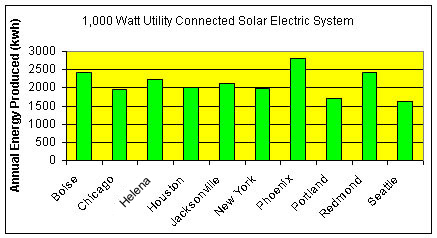 Solar energy technologies work well in the Northwest. The graph shows that many Northwest cities, including Helena, rank above Jacksonville, Florida, and are nearly as good as Phoenix. Longer summer days and cooler temperatures add up to higher performance.
Montana's abundant solar resource can be used to save energy in residential and commercial construction, and farming, ranching, recreation and other industries. The amount of sunshine available at a given location is called the "solar resource" or insolation. The amount of electrical energy produced by a PV array depends on the insolation at a given location and the collector bank orientation, tilt angle, and module efficiency.
Montana can be divided for insolation roughly the way it is divided geographically - Eastern Montana and Western Montana. Eastern Montana receives an annual average of 5 hours of full sun; Western Montana receives an annual average of 4.2 hours.
Browse these pages for information about solar basics. Solar dealers and installers are usually the best source of how-to information for people contemplating a solar project for a home or business. See our directory of Montana renewable energy dealers and installers to find a dealer in your area.