



 Sun4Schools Curriculum
The Power of Solar Energy
Lesson 3 ~ What is Solar Energy?
Objectives
Background
Activity 1: Which Material Best Stores Solar Energy?
Activity 2: In Collecting Solar Energy, Is Bigger Better?
Wrap-up
Objectives
- Students will explain what solar energy is.
- Students will demonstrate how different variables increase or decrease solar energy potential.
Background
The sun is a giant energy source. For many years, people have been using the sun's energy, called solar energy, to make buildings brighter and warmer. Today, we use special equipment and specially designed buildings to capture solar energy for lighting, to heat our living spaces and our water, and even to produce electricity.
Capturing and using solar energy has become more important than ever. Traditional fuels like natural gas and oil are limited, and as these fuels become more scarce, their cost increases. Solar energy also is non-polluting and thus helps us achieve a cleaner environment.
If you collect enough solar heat, you can use it instead of heat from a furnace. One way to collect heat is to trap solar energy with solar collectors. Solar collectors allow sunlight in through plastic or glass, absorbing that sunlight and convert it to heat. Because the heat is unable to pass easily through the plastic or glass, it is trapped inside the collector. An example of how a solar collector works is a car that has all its windows closed tightly. When sunlight passes through the windows of the car, it is either absorbed by the seats and other surfaces inside the car, or it is reflected back out through the window. Light that is absorbed changes into heat. Darker colored surfaces absorb more sunlight than lighter colors. Similarly, different materials hold heat more efficiently than others and are thus better suited to store solar energy.
Solar collectors come in many shapes and sizes. Passive solar collectors move heat from the collectors to other spaces naturally, without the use of fans or pumps. An attached sunroom or a south-facing room with a large window area and a tile floor (which serves to collect, retain, and then release heat) are examples of passive solar heating systems. Active solar systems use fans (for systems that heat the air) or pumps (for systems that heat water) to move the heat from the collector to another part of the building.
Activity 1: Which Material Best Stores Solar Energy?
(Source: Solar Energy Research and Education Foundation-SEREF)
Materials:
- Cardboard box
- Black paint
- Four small metal cans
- Four thermometers
- Sand
- Salt
- Water
- Torn-up paper
- Scale
Method:
- Paint the entire surface of the box (inside and outside) with the black paint.
- Place the box in the sun.
- Pick the can to hold the torn paper, place a thermometer in the can and using the scale, record the combined weight (grams).
- Position the thermometer in the middle of the can and pack torn paper into the can; filling the bottom of the can, around the thermometer, and up to the top of the can.
- Record the weight of the torn-paper filled can. Subtract the initial weight from the filled weight to determine how much torn paper you added to the can.
- Use the scale to weigh each can and then add an equivalent weight of the salt, water, or sand equal to the weight of the torn paper.
- In each can, attach the thermometer such that the thermometer is positioned in the middle of the material inside.
- Place the cans in the box.
- Close the box and leave it for half an hour.
- Remove the cans.
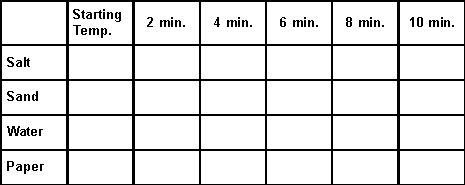
- Watch the temperatures in each can fall and record the temperatures for each on the chart below.
- Using this information, determine which material best stores heat.
Activity 2: In Collecting Solar Energy, Is Bigger Better?
(Source: Solar Energy Research and Education Foundation-SEREF)
Materials:
- Large disposable pie plate
- Small disposable pie plate
- Black paint (non-water-soluble spray paint is easiest)
- Thermometer
- Metric measuring cup
- Clear plastic food wrap
- Newspapers
- Styrofoam cups
- Masking tape
- Water
Method:
- Paint both pie plates black.
- When the paint dries, add 100ml of water to each pie plate.
- Record the temperature of the water in each plate.
- Wrap plastic tightly over them.
- Tape the plastic securely.
- Place each on a stack of newspapers in the sun for 10 minutes.
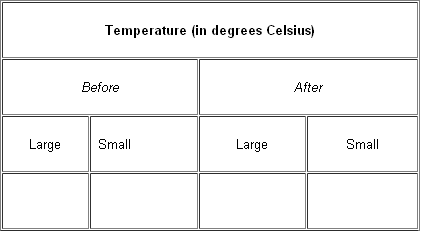
- Pour the water into styrofoam cups and measure the temperatures, recording the temperatures below.
- Using this information, determine which plate had hotter water.
Wrap-up
Lead a class discussion about how these concepts would be applied to designing a solar energy system. Your students should demonstrate an understanding of why surface area of the solar collector and the choice of storage material will affect the system's performance.
» Next Section: Lesson 4 ~ How Is Solar Energy Used to Heat Water?
« Back to Solar Projects Page